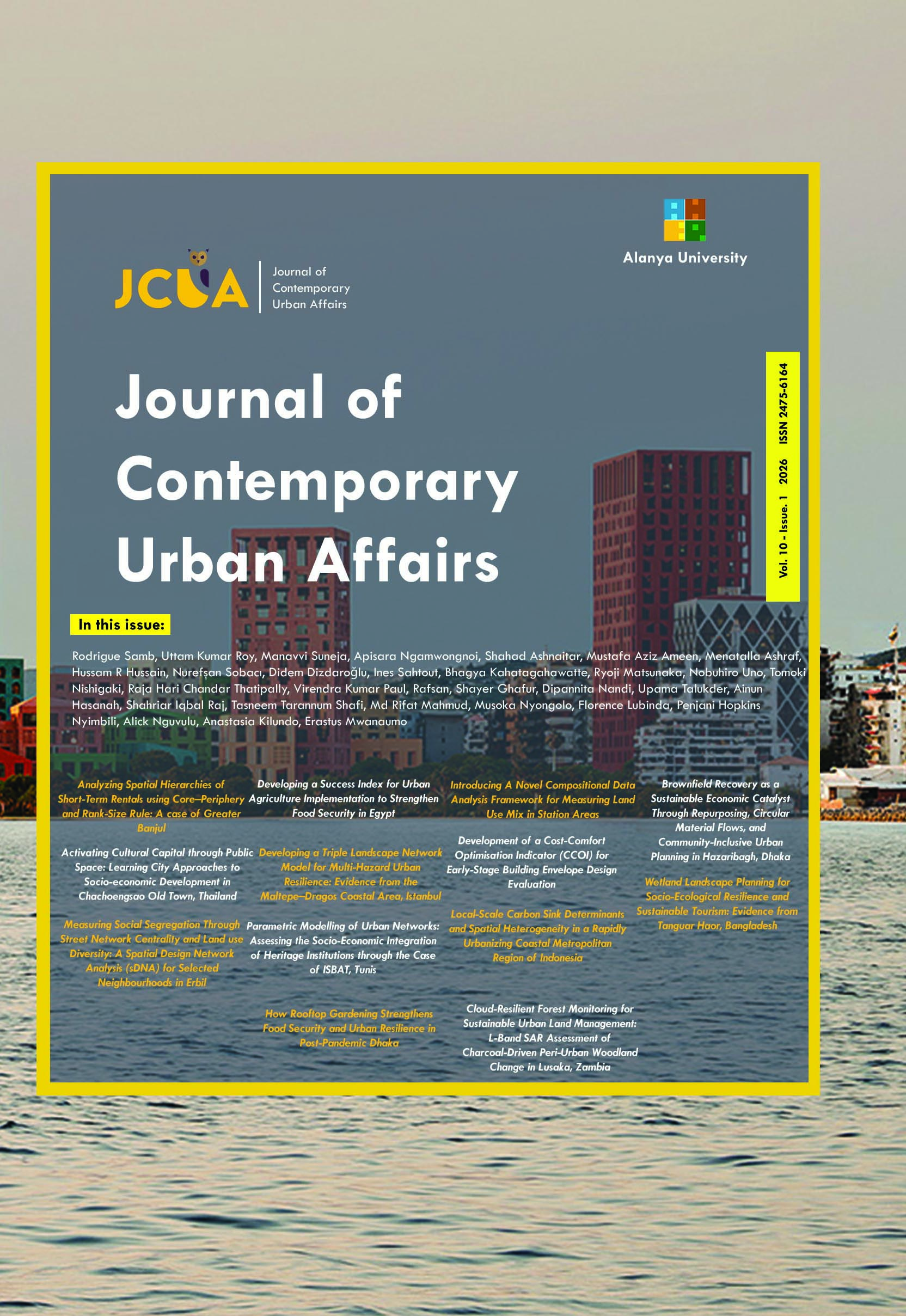
Analyzing Spatial Hierarchies of Short-Term Rentals using Core–Periphery and Rank-Size Rule: A case of Greater Banjul
DOI:
https://doi.org/10.25034/ijcua.2026.v10n1-1Keywords:
Short-Term Rentals, Airbnb Market, Core–Periphery Structure, Rank-Size Rule, Urban HierarchyAbstract
Short-Term Rental (STR) platforms increasingly reshape housing, tourism, and urban economies, yet their spatial organization in Sub-Saharan African cities remains poorly understood. This study addresses this gap by examining Airbnb market hierarchy in Greater Banjul Area, The Gambia, where tourism growth intersects with uneven urban development. Using 5,657 Airbnb listings collected between September 2024 and July 2025, the study applies an integrated framework combining K-Means clustering, DBSCAN, Global and Local Moran’s I, sensitivity testing, and Zipf rank-size modelling. The results identify a significant core–periphery structure, with core listings concentrated along the Kololi–Senegambia–Fajara coastal corridor and peripheral listings dispersed inland. Positive spatial autocorrelation is robust (Moran’s I = 0.480, p < 0.001). Market segmentation is driven mainly by host rating (η² = 0.639), guest satisfaction (η² = 0.628), and capacity, while price has negligible explanatory power (η² = 0.009). Supply follows a near-Zipfian hierarchy (α = 1.143), whereas price and stay length remain flatter. The findings support differentiated STR regulation, improve tourism infrastructure planning, and guide resource allocation, housing protection, and investment strategies in African urban economies. Originality lies in linking spatial hierarchy with platform-mediated urban tourism governance and urban management.
Downloads
References
Adamiak, C. (2022). Current state and development of Airbnb accommodation offer in 167 countries. Current Issues in Tourism, 25(19), 3131–3149. https://doi.org/10.1080/13683500.2019.1696758
Adamiak, C., & Marjavaara, R. (2023). Airbnb and urban population change: An empirical analysis of the case of Stockholm, Sweden. Urban Research & Practice, 17(5), 654–680. https://doi.org/10.1080/17535069.2023.2286521
Albuquerque, H., Quintela, J. A., & Marques, J. (2024). The impact of short-term rental accommodation in urban tourism: A comparative analysis of tourists’ and residents’ perspectives. Urban Science, 8(3), 83. https://doi.org/10.3390/urbansci8030083
Álvarez-Herranz, A., & Macedo-Ruíz, E. (2025). Determinants of the price of Airbnb accommodations through a weighted spatial regression model: A case of the Autonomous City of Buenos Aires. Sustainability, 17(21), 9364. https://doi.org/10.3390/su17219364
Anselin, L. (1995). Local indicators of spatial association—LISA. Geographical Analysis, 27(2), 93–115. https://doi.org/10.1111/j.1538-4632.1995.tb00338.x
Ardura Urquiaga, A., Lorente-Riverola, I., & Ruiz Sanchez, J. (2020). Platform-mediated short-term rentals and gentrification in Madrid. Urban Studies, 57(15), 3095–3115. https://doi.org/10.1177/0042098020918154
Aritenang, A. F., & Iskandar, Z. S. (2023). Tourism gentrification and P2P accommodation: The case of Airbnb in Bandung City. City, Culture and Society, 35, 100548. https://doi.org/10.1016/j.ccs.2023.100548
Auerbach, F., & Ciccone, A. (2023). The law of population concentration. Environment and Planning B: Urban Analytics and City Science, 50(2), 290–298. https://doi.org/10.1177/23998083221147139
Bao, H. X. H., & Shah, S. (2020). The impact of home sharing on residential real estate markets. Journal of Risk and Financial Management, 13(8), 161. https://doi.org/10.3390/jrfm13080161
Barron, K., Kung, E., & Proserpio, D. (2021). The effect of home-sharing on house prices and rents: Evidence from Airbnb. Marketing Science, 40(1), 23–47. https://doi.org/10.1287/mksc.2020.1227
Bivand, R. S., & Wong, D. W. S. (2018). Comparing implementations of global and local indicators of spatial association. TEST, 27(3), 716–748. https://doi.org/10.1007/s11749-018-0599-x
Bonaventura, M., Aiello, L. M., Quercia, D., & Latora, V. (2021). Predicting urban innovation from the US Workforce Mobility Network. Humanities and Social Sciences Communications, 8, 10. https://doi.org/10.1057/s41599-020-00685-7
Brynjolfsson, E., Hu, Y. J., & Smith, M. D. (2010). Long tails versus superstars: The effect of information technology on product variety and sales concentration patterns. Information Systems Research, 21(4), 736–747. https://doi.org/10.1287/isre.1100.0325
Carollo, I. M., et al. (2024). Is the effect of Airbnb on the housing market different in medium-sized cities? Evidence from a Southern European city. Urban Research & Practice, 17(2), 260–279. https://doi.org/10.1080/17535069.2023.2179419
Chica-Olmo, J., González-Morales, J. G., & Zafra-Gómez, J. L. (2020). Effects of location on Airbnb apartment pricing in Málaga. Tourism Management, 77, 103981. https://doi.org/10.1016/j.tourman.2019.103981
Clauset, A., Shalizi, C. R., & Newman, M. E. J. (2009). Power-law distributions in empirical data. SIAM Review, 51(4), 661–703. https://doi.org/10.1137/070710111
Dombrowski, T. P., Narayanan, R. P., & Pace, R. K. (2023). The rank-size rule and challenges in diversifying commercial real estate portfolios. The Journal of Real Estate Finance and Economics, 67(1), 1–28. https://doi.org/10.1007/s11146-020-09765-6
Duran, H. E. (2021). The distribution of city sizes in Turkey: A failure of Zipf’s law due to concavity. Regional Science Policy & Practice, 13(5), 1702–1719. https://doi.org/10.1111/rsp3.12449
Franco, S. F., & Santos, C. D. (2021). The impact of Airbnb on residential property values and rents: Evidence from Portugal. Regional Science and Urban Economics, 88, 103667. https://doi.org/10.1016/j.regsciurbeco.2021.103667
Gabaix, X. (1999). Zipf’s law for cities: An explanation. The Quarterly Journal of Economics, 114(3), 739–767. https://doi.org/10.1162/003355399556133
Gabaix, X., & Ibragimov, R. (2012). Rank − 1/2: A simple way to improve the OLS estimation of tail exponents. Journal of Business & Economic Statistics, 29(1), 24–39. https://doi.org/10.1198/jbes.2009.06157
Garcia-López, M. À., Jofre-Monseny, J., Martínez-Mazza, R., & Segú, M. (2020). Do short-term rental platforms affect housing markets? Evidence from Airbnb in Barcelona. Journal of Urban Economics, 119, 103278. https://doi.org/10.1016/j.jue.2020.103278
Gómez-Liévano, A., & Youn, H. (2012). The statistics of urban scaling and their connection to Zipf’s law. PLOS ONE, 7(7), e40393. https://doi.org/10.1371/journal.pone.0040393
Gössling, S., & Hall, C. M. (2019). Sharing versus collaborative economy: How to align ICT developments and the SDGs in tourism? Journal of Sustainable Tourism, 27(1), 74–96. https://doi.org/10.1080/09669582.2018.1560455
Grisdale, S. (2021). Displacement by disruption: Short-term rentals and the political economy of “belonging anywhere” in Toronto. Urban Geography, 42(5), 654–680. https://doi.org/10.1080/02723638.2019.1642714
Gutiérrez, A., & Domènech, A. (2020). Understanding the spatiality of short-term rentals in Spain: Airbnb and the intensification of the commodification of housing. Geografisk Tidsskrift-Danish Journal of Geography, 120(2), 98–113. https://doi.org/10.1080/00167223.2020.1769492
Gutiérrez, J., García-Palomares, J. C., Romanillos, G., & Salas-Olmedo, M. H. (2017). The eruption of Airbnb in tourist cities: Comparing spatial patterns of hotels and peer-to-peer accommodation in Barcelona. Tourism Management, 62, 278–291. https://doi.org/10.1016/j.tourman.2017.05.003
Gyódi, K., & Nawaro, Ł. (2021). Determinants of Airbnb prices in European cities: A spatial econometrics approach. Tourism Management, 86, 104319. https://doi.org/10.1016/j.tourman.2021.104319
Harten, J. G., & Boeing, G. (2024). Access to the exclusive city: Home sharing as an affordable housing strategy. Urban Studies, 61(16), 3069–3085. https://doi.org/10.1177/00420980241258297
He, M., & Jin, J. (2024). Does Airbnb raise local rent in Seoul? Spatial 2SLS model approach. International Journal of Urban Sciences, 29(4), 985–1011. https://doi.org/10.1080/12265934.2024.2397959
Hennig, C., & Liao, T. F. (2013). How to find an appropriate clustering for mixed-type variables with application to socio-economic stratification. Journal of the Royal Statistical Society: Series C (Applied Statistics), 62(3), 309–369. https://doi.org/10.1111/j.1467-9876.2012.01066.x
Hidalgo, A., Riccaboni, M., & Velazquez, F. J. (2023). When local business faded away: The uneven impact of Airbnb on the geography of economic activities. Cambridge Journal of Regions, Economy and Society, 16(2), 335–348. https://doi.org/10.1093/cjres/rsad009
Huang, Z. (1998). Extensions to the k-means algorithm for clustering large data sets with categorical values. Data Mining and Knowledge Discovery, 2(3), 283–304. https://doi.org/10.1023/A:1009769707641
Hübscher, M., & Borst, M. (2023). On the relationship between short-term rentals and gentrification: The case of Airbnb in Munich, Germany. Geografie, 128(1), 1–24. https://doi.org/10.37040/geografie.2022.013
Hur, D., Lee, S., & Kim, H. (2024). The impact of Airbnb on long-term rental markets in San Francisco: A geospatial analysis using multiscale geographically weighted regression. ISPRS International Journal of Geo-Information, 13(9), 298. https://doi.org/10.3390/ijgi13090298
Christie, I., Fernandes, E., Messerli, H., & Twining-Ward, L. (2014). Tourism in Africa: Harnessing tourism for growth and improved livelihoods. World Bank. https://doi.org/10.1596/978-1-4648-0190-7
Ioannides, Y., & Skouras, S. (2013). US city size distribution: Robustly Pareto, but only in the tail. Journal of Urban Economics, 73(1), 18–29. https://doi.org/10.1016/j.jue.2012.06.005
Ioannides, Y. M., & Overman, H. G. (2003). Zipf’s law for cities: An empirical examination. Regional Science and Urban Economics, 33(2), 127–137. https://doi.org/10.1016/S0166-0462(02)00006-6
Jiao, J., & Bai, S. (2020). Cities reshaped by Airbnb: A case study in New York City, Chicago, and Los Angeles. Environment and Planning A: Economy and Space, 52(1), 10–13. https://doi.org/10.1177/0308518X19853275
Klimczuk, A., & Klimczuk-Kochańska, M. (2021). Core-periphery model. In S. N. Romaniuk, M. Thapa, & P. Marton (Eds.), The Palgrave encyclopedia of global security studies (pp. 1–8). Palgrave Macmillan. https://doi.org/10.1007/978-3-319-74336-3_320-1
Yoğurtçu, F. B., & Köksal, A. (2024). District-based rental value coefficients for shopping mall development in Istanbul. Journal of Contemporary Urban Affairs, 8(2), 476–487. https://doi.org/10.25034/ijcua.2024.v8n2-11
Krugman, P. (1991). Increasing returns and economic geography. Journal of Political Economy, 99(3), 483–499. https://doi.org/10.1086/261763
Kubara, M., & Kopczewska, K. (2024). Akaike information criterion in choosing the optimal k-nearest neighbours of the spatial weight matrix. Spatial Economic Analysis, 19(1), 76–99. https://doi.org/10.1080/17421772.2023.2176539
Liu, P., et al. (2024). A modified and weighted Gower distance-based clustering analysis for mixed type data: A simulation and empirical analyses. BMC Medical Research Methodology, 24, 8. https://doi.org/10.1186/s12874-024-02427-8
Mermet, A. C. (2021). Who is benefiting from Airbnb? Assessing the redistributive power of peer-to-peer short-term rentals. The Professional Geographer, 73(3), 553–566. https://doi.org/10.1080/00330124.2021.1906921
Na, Y., & Liu, X. (2025). Unveiling the core-periphery dynamics and driving factors of intercity scientific mobility in China. Habitat International, 163, 103481. https://doi.org/10.1016/j.habitatint.2025.103481
Nalin, A., et al. (2023). Unveiling the socio-economic fragility of a major urban touristic destination through open data and Airbnb data: The case study of Bologna, Italy. Smart Cities, 6(6), 3138–3160. https://doi.org/10.3390/smartcities6060140
Nawaro, Ł. (2021). Determinants of Airbnb prices in European cities: A spatial econometrics approach. Tourism Management, 86, 104319. https://doi.org/10.1016/j.tourman.2021.104319
Ohtake, K. (2025). Continuous space core-periphery model with transport costs in differentiated agriculture. Portuguese Economic Journal, 24(3), 469–502. https://doi.org/10.1007/s10258-025-00273-0
Panahandeh, A., Rabiei-Dastjerdi, H., Goktas, P., & McArdle, G. (2025). Answering new urban questions: Using eXplainable AI-driven analysis to identify determinants of Airbnb price in Dublin. Expert Systems with Applications, 260, 125360. https://doi.org/10.1016/j.eswa.2024.125360
Rabiei-Dastjerdi, H., McArdle, G., Matthews, S. A., & Keenan, P. (2021). Gap analysis in decision support systems for real-estate in the era of the digital earth. International Journal of Digital Earth, 14(1), 121–138. https://doi.org/10.1080/17538947.2020.1808719
Albert, R., & Barabási, A.-L. (2002). Statistical mechanics of complex networks. Reviews of Modern Physics, 74(1), 47–97. https://doi.org/10.1103/RevModPhys.74.47
Rodríguez-Pérez de Arenaza, D., Hierro, L. Á., & Patiño, D. (2022). Airbnb, sun-and-beach tourism and residential rental prices: The case of the coast of Andalusia, Spain. Current Issues in Tourism, 25(20), 3261–3278. https://doi.org/10.1080/13683500.2019.1705768
Rogerson, C. M., & Visser, G. (2011). African tourism geographies: Existing paths and new directions. Tijdschrift voor Economische en Sociale Geografie, 102(3), 251–259. https://doi.org/10.1111/j.1467-9663.2011.00661.x
Roy, U. K., & Mishra, P. (2024). Exploring commercial development in Delhi’s mixed-use neighbourhoods: An empirical study. Journal of Contemporary Urban Affairs, 8(1), 271–288. https://doi.org/10.25034/ijcua.2024.v8n1-15
Rybski, D., & Ciccone, A. (2023). Auerbach, Lotka, and Zipf: Pioneers of power-law city-size distributions. Archive for History of Exact Sciences, 77(6), 601–613. https://doi.org/10.1007/s00407-023-00314-0
Samb, R., et al. (2026). Machine learning driven land surface temperature prediction and urban heat risk assessment in the Gambia. Discover Cities, 3, 49. https://doi.org/10.1007/s44327-026-00230-2
Sarkar, A., Pick, J. B., & Jabeen, S. (2024). Spatiotemporal patterns and socioeconomic influences on host participation in short-term rental markets: Airbnb in San Francisco. ISPRS International Journal of Geo-Information, 13(1), 4. https://doi.org/10.3390/ijgi13010004
Sateriano, A., Quaranta, G., Salvia, R., Saneugenio, F. E., Marucci, A., Salvati, L., Zagaglia, B., & Chelli, F. (2024). Envisaging the intrinsic departure from Zipf’s law as an indicator of economic concentration along urban–rural gradients. Land, 13(4), 415. https://doi.org/10.3390/land13040415
Sharma, D., & Roy, U. K. (2024). Economic implications and public readiness for urban green space development in Agra: A strategic evaluation in the City of Taj. Journal of Contemporary Urban Affairs, 8(2), 529–545. https://doi.org/10.25034/ijcua.2024.v8n2-14
Shen, X., et al. (2021). Finding core-periphery structures in large networks. Physica A: Statistical Mechanics and Its Applications, 581, 126224. https://doi.org/10.1016/j.physa.2021.126224
Sridhar, K. S. (2022). Understanding the digital platform economy: Effect of Airbnb on housing in Indian cities. Housing Policy Debate, 32(4–5), 713–729. https://doi.org/10.1080/10511482.2021.1929389
Storper, M., & Scott, A. J. (2016). Current debates in urban theory: A critical assessment. Urban Studies, 53(6), 1114–1136. https://doi.org/10.1177/0042098016634002
Sun, S., Wang, X., & Hu, M. (2022). Spatial distribution of Airbnb and its influencing factors: A case study of Suzhou, China. Applied Geography, 139, 102641. https://doi.org/10.1016/j.apgeog.2022.102641
Yang, T., & Zhang, Y. (2025). Urban systems science and cross-scale dynamics: A conceptual framework to advance integrated planning and governance. Transactions in Planning and Urban Research, 4(1), 3–13. https://doi.org/10.1177/27541223251325264
Toader, V., Negrușa, A. L., Bode, O. R., & Rus, R. V. (2022). Analysis of price determinants in the case of Airbnb listings. Economic Research-Ekonomska Istraživanja, 35(1), 2493–2509. https://doi.org/10.1080/1331677X.2021.1962380
Tong, B., & Gunter, U. (2022). Hedonic pricing and the sharing economy: How profile characteristics affect Airbnb accommodation prices in Barcelona, Madrid, and Seville. Current Issues in Tourism, 25(20), 3309–3328. https://doi.org/10.1080/13683500.2020.1718619
Wang, D., & Nicolau, J. L. (2017). Price determinants of sharing economy-based accommodation rental: A study of listings from 33 cities on Airbnb.com. International Journal of Hospitality Management, 62, 120–131. https://doi.org/10.1016/j.ijhm.2016.12.007
Wen, J., Jansen, S. J. T., van der Heijden, H., & Boelhouwer, P. J. (2025). Migration across the urban hierarchy: Has China’s urbanisation transitioned from the primate city stage to the secondary city stage? Urban Studies, 62(4), 665–681. https://doi.org/10.1177/00420980241259923
Wicker, T. (2026). Winsorizing and trimming in RCTs. Journal of Development Economics, 182, 103815. https://doi.org/10.1016/j.jdeveco.2026.103815
Wongoutong, C. (2024). The impact of neglecting feature scaling in k-means clustering. PLOS ONE, 19(12), e0310839. https://doi.org/10.1371/journal.pone.0310839
Xiaoqian, F., et al. (2023). Dynamic changes in urban land spatial inequality under the core-periphery structure in urban agglomerations. Journal of Geographical Sciences, 33, 760–778. https://doi.org/10.1007/s11442-023-2105-y
Xu, M., & Xu, Y. (2021). What happens when Airbnb comes to the neighborhood: The impact of home-sharing on neighborhood investment. Regional Science and Urban Economics, 88, 103670. https://doi.org/10.1016/j.regsciurbeco.2021.103670
Zhou, Y., Zheng, W., Wang, X., & Du, N. (2024). Urban economic efficiency under the interactive effect of urban hierarchy and connection networks in China. Journal of Geographical Sciences, 34(12), 2315–2332. https://doi.org/10.1007/s11442-024-2294-z
Zhu, Y., & Liu, S. (2024). The moderating effects of Airbnb between urban conservation and housing rental market: A case study of Shanghai. Cities, 150, 105044. https://doi.org/10.1016/j.cities.2024.105044
Published
Issue
Section
License
Copyright (c) 2026 Rodrigue Samb, Uttam Kumar Roy, Manavvi Suneja

This work is licensed under a Creative Commons Attribution 4.0 International License.