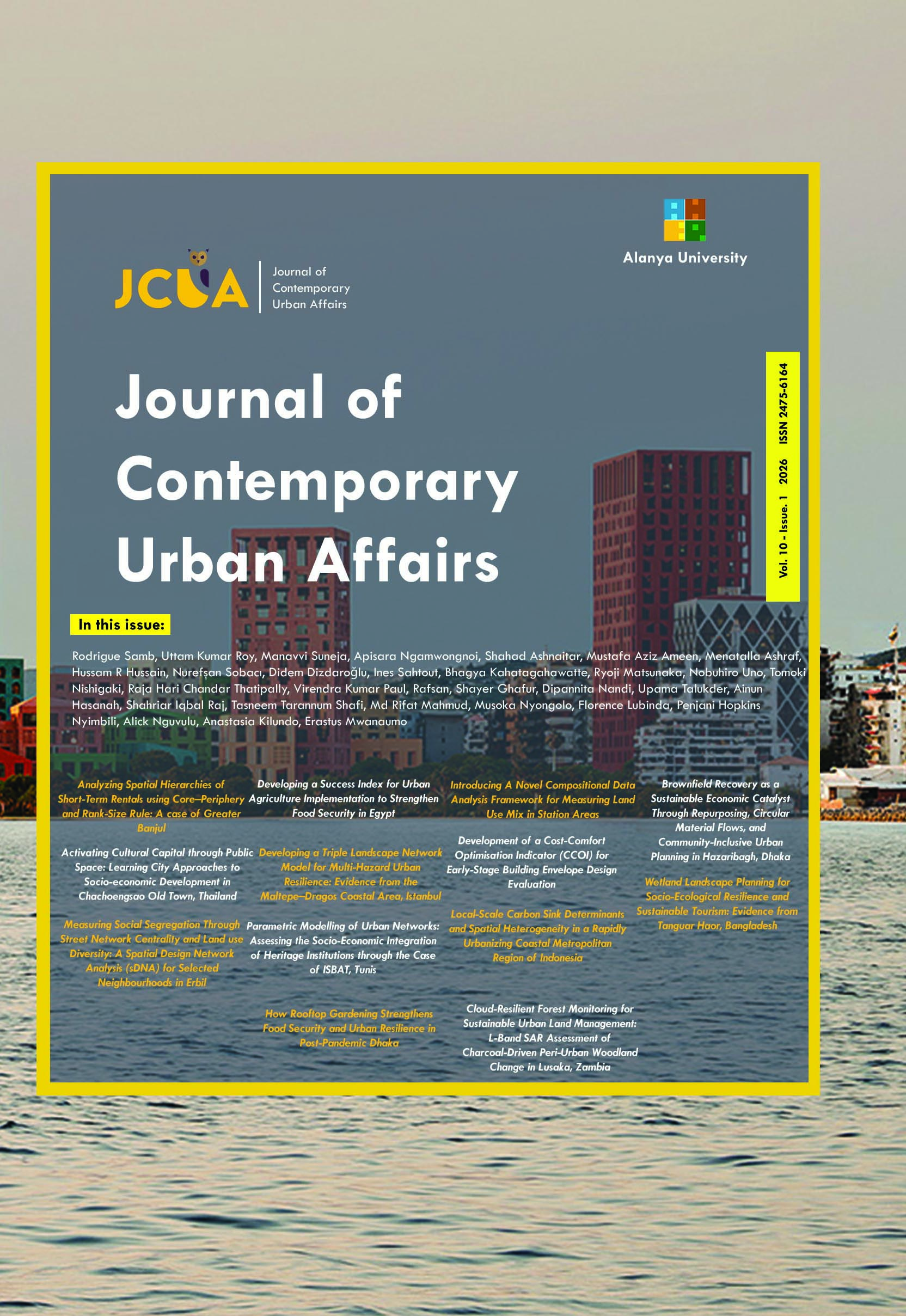
How Rooftop Gardening Strengthens Food Security and Urban Resilience in Post-Pandemic Dhaka
DOI:
https://doi.org/10.25034/ijcua.2026.v10n1-12Keywords:
Rooftop Gardening, Urban Agriculture, Urban Resilience, Social Resilience, Women's EmpowermentAbstract
Dense South Asian cities experienced severe food insecurity, income loss, and psychological strain during COVID-19, yet household-level evidence on rooftop gardening as crisis adaptation remains limited. This study investigates how the pandemic shaped rooftop gardening adoption and socio-economic resilience in Mohammadpur, Dhaka. A quantitative cross-sectional survey of 150 households compared 90 gardening adopters with 60 non-adopters, using descriptive statistics, t-tests, chi-square tests, and exploratory logistic regression. Findings show that 59.33% of households experienced pandemic-related income loss, while adopters reported higher peak stress than non-adopters but significantly lower current stress. Female respondents were 3.6 times more likely to adopt gardening, and households with full rooftop access were approximately 25 times more likely to garden than those without access. Food worry, gender, peak stress, and rooftop access emerged as key predictors, while 83.33% of respondents remained unaware of government or non-government urban agriculture initiatives. The findings demonstrate that rooftop gardening can reduce household food concerns, support mental wellbeing, strengthen women’s food-related agency, and improve resource efficiency in dense neighbourhoods. By linking community microagriculture with urban economic resilience, the study offers practical guidance for inclusive planning, urban food governance, and sustainable urban management.
Downloads
References
Ajzen, I. (2020). The theory of planned behavior: Frequently asked questions. Human Behavior and Emerging Technologies, 2(4), 314–324. https://doi.org/10.1002/hbe2.195
Akter, A., Hoque, F., Rahman, Md. S., Kiprop, E., Shah Jahan, M., & Geng, X. (2020). Determinants of adoption of homestead gardening by women and effect on their income and decision-making power. Journal of Applied Horticulture, 23(1), 59–64. https://doi.org/10.37855/jah.2021.v23i01.12
Alam, Md. Z. (2021). Is population density a risk factor for communicable diseases like COVID-19? A case of Bangladesh. Asia Pacific Journal of Public Health, 33(8), 949–950. https://doi.org/10.1177/1010539521998858
Barthel, S., Parker, J., & Ernstson, H. (2015). Food and green space in cities: A resilience lens on gardens and urban environmental movements. Urban Studies, 52(7), 1321–1338. https://doi.org/10.1177/0042098012472744
Bellini, A., Bartoli, F., & Caneva, G. (2024). Extensive green roofs (EGRs) and the five Ws: A quantitative analysis on the origin and evolution, aims, approaches, and botanical views. Sustainability, 16(3), 1033. https://doi.org/10.3390/su16031033
Benanda Yasminingrat, R. A., Sulistyantara, B., & Nasrullah, N. (2023). The impact of urban home gardens on the mental well-being of women in the Greater Jakarta Area. Journal of Contemporary Urban Affairs, 7(1), 39–50. https://doi.org/10.25034/ijcua.2023.v7n1-3
Bhuiyan, Md. A. R., & Ferdous, Z. (2021). Human perspectives on rooftop gardening for ensuring food security in the COVID-19 situation in Dhaka City, Bangladesh. Big Data in Agriculture, 3(2), 74–78. https://doi.org/10.26480/bda.02.2021.74.78
Bosnjak, M., Ajzen, I., & Schmidt, P. (2020). The theory of planned behavior: Selected recent advances and applications. Europe’s Journal of Psychology, 16(3), 352–356. https://doi.org/10.5964/ejop.v16i3.3107
Cameron, H. A., & Schoenfeld, T. J. (2018). Behavioral and structural adaptations to stress. Frontiers in Neuroendocrinology, 49, 106–113. https://doi.org/10.1016/j.yfrne.2018.02.002
Carroll, A. A., Lamm, K. W., Carpenter, K. N., Croom, D. B., Fuhrman, N. E., & Fan, H. (2025). Extension agent intention to participate in supplemental professional development programming. Journal of Agricultural Education, 66(4), Article 14. https://doi.org/10.5032/jae.v66i4.3176
Chen‐Fa Wu, Luu Van Thong Trac, Szu‐Hung Chen, Alisara Menakanit, Quoc Tuan Le, Hung‐Ming Tu, C. H. Tsou, Hsi-Chih Huang, Nittaya Chookoh, Chih-Cheng Weng, Li‐Wei Chou, & Chiu-Chuan Chen. (2023). Enhancing human resilience beyond COVID-19-related stress: Public responses to multi-benefits of home gardening. Scientific Reports, 13, 10534. https://doi.org/10.1038/s41598-023-37426-0
Clapp, J., Moseley, W. G., Burlingame, B., & Termine, P. (2022). Viewpoint: The case for a six-dimensional food security framework. Food Policy, 106, 102164. https://doi.org/10.1016/j.foodpol.2021.102164
Conner, M. (2020). Theory of planned behavior. In G. Tenenbaum & R. C. Eklund (Eds.), Handbook of sport psychology (4th ed., pp. 1–18). Wiley. https://doi.org/10.1002/9781119568124.ch1
Cooper, S. J., & Wheeler, T. (2015). Adaptive governance: Livelihood innovation for climate resilience in Uganda. Geoforum, 65, 96–107. https://doi.org/10.1016/j.geoforum.2015.07.015
Dlamini, S. B., & Dludlu, H. P. (2025). Evaluating community led initiatives’ impact on food security, resilience, and cohesion in Maphalaleni, Eswatini. International Journal of Scientific Research and Engineering Development, 8(4), 903–913. https://doi.org/10.5281/zenodo.16411302
Efimova, O. I., Salakhova, V. B., Mikhaylova, I. V., Gnedova, S. B., Chertushkina, T. A., & Agadzhanova, E. R. (2015). Theoretical review of scientific approaches to understanding crisis psychology. Mediterranean Journal of Social Sciences, 6(2 S3), 241–245. https://doi.org/10.5901/mjss.2015.v6n2s3p241
Ehab, A., & Heath, T. (2024). Rethinking the design of vertical green spaces in the post-pandemic era: Visitor behaviour and real-life cognitive experience at Crossrail Place, London. In A. Cheshmehzangi, M. Sedrez, H. Zhao, T. Li, T. Heath, & A. Dawodu (Eds.), Resilience vs pandemics (pp. 13–35). Springer Nature Singapore. https://doi.org/10.1007/978-981-99-8672-9_2
French, C., Becker, M., & Lindsay, B. (2010). Havana’s changing urban agriculture landscape: A shift to the right? Journal of Agriculture, Food Systems, and Community Development, 1(2), 155–165. https://doi.org/10.5304/jafscd.2010.012.013
Gajbe, P. U. (2020). Urban rooftop farming: Model for sustainable vegetable production and environmental well-being. Agricultural Science Digest - A Research Journal, 41(Special Issue), 211–214. https://doi.org/10.18805/ag.D-5215
Gerdes, M. E., Aistis, L. A., Sachs, N. A., Williams, M., Roberts, J. D., & Rosenberg Goldstein, R. E. (2022). Reducing anxiety with nature and gardening (RANG): Evaluating the impacts of gardening and outdoor activities on anxiety among U.S. adults during the COVID-19 pandemic. International Journal of Environmental Research and Public Health, 19(9), 5121. https://doi.org/10.3390/ijerph19095121
Ghosh, S. (2021). Urban agriculture on the rooftop. JOJ Horticulture & Arboriculture, 3(3), 555611. https://doi.org/10.19080/JOJHA.2021.03.555611
Hamilton, B., & Terblanche-Smit, M. (2018). Consumer intention to purchase green vehicles in the South African market: A theory of planned behaviour perspective. South African Journal of Business Management, 49(1), Article a190. https://doi.org/10.4102/sajbm.v49i1.190
Lee, J., Cerreto, F. A., & Lee, J. (2010). Theory of planned behavior and teachers’ decisions regarding use of educational technology. Journal of Educational Technology & Society, 13(1), 152–164. https://www.jstor.org/stable/jeductechsoci.13.1.152
Khan, M. M., Akram, M. T., Janke, R., Qadri, R. W. K., Al-Sadi, A. M., & Farooque, A. A. (2020). Urban horticulture for food secure cities through and beyond COVID-19. Sustainability, 12(22), 9592. https://doi.org/10.3390/su12229592
Kiriakidis, S. (2017). Perceived behavioural control in the theory of planned behaviour: Variability of conceptualisation and operationalisation and implications for measurement. In A. Kavoura, D. P. Sakas, & P. Tomaras (Eds.), Strategic innovative marketing (pp. 197–202). Springer International Publishing. https://doi.org/10.1007/978-3-319-33865-1_25
Komalawati, K., Sarjana, Romdon, A. S., Hartono, F. R., Murtiati, S., Arianti, F. D., Hariyanto, W., & Oelviani, R. (2022). Urban farming as a resilient strategy during COVID-19 pandemic. Journal of Resilient Economies, 2(1), 39–48. https://doi.org/10.25120/jre.2.1.2022.3910
Lal, R. (2020). Home gardening and urban agriculture for advancing food and nutritional security in response to the COVID-19 pandemic. Food Security, 12(4), 871–876. https://doi.org/10.1007/s12571-020-01058-3
Lazuardi, S. N., Sulistyantara, B., & Pratiwi, P. I. (2022). The role of home gardens in developing cities for improving workers’ psychological conditions. Journal of Contemporary Urban Affairs, 6(2), 233–248. https://doi.org/10.25034/ijcua.2022.v6n2-9
Manita, E., Mawarpury, M., Khairani, M., & Sari, K. (2019). Hubungan stres dan kesejahteraan (well-being) dengan moderasi kebersyukuran. Gadjah Mada Journal of Psychology (GamaJoP), 5(2), 178–186. https://doi.org/10.22146/gamajop.50121
Momtaz, T. S. (2020). Urban agricultural practices in the megacities of Dhaka and Mumbai. In R. Roggema & A. Roggema (Eds.), Smart and sustainable cities and buildings (pp. 297–306). Springer International Publishing. https://doi.org/10.1007/978-3-030-37635-2_20
Perera, T. G. U. P., Wickramaarachchi, N. C., Karunarathne, H. M. L. P., Munasinghe, L. M., & Rupasinghe, K. (2021). COVID-19 lockdown home gardening in the Western Province of Sri Lanka. Journal of Social Sciences and Humanities Review, 6(2), 79–105. https://doi.org/10.4038/jsshr.v6i2.63
Pons, O., Nadal, A., Sanyé-Mengual, E., Llorach-Massana, P., Cuerva, E., Sanjuan-Delmàs, D., Muñoz, P., Oliver-Solà, J., Planas, C., & Rovira, M. R. (2015). Roofs of the future: Rooftop greenhouses to improve buildings metabolism. Procedia Engineering, 123, 441–448. https://doi.org/10.1016/j.proeng.2015.10.084
Pulighe, G., & Lupia, F. (2020). Food first: COVID-19 outbreak and cities lockdown a booster for a wider vision on urban agriculture. Sustainability, 12(12), 5012. https://doi.org/10.3390/su12125012
Rahman, A., Ai Ping, T., Mubeen, S. K., Mahmud, I., & Abbasi, G. A. (2022). What influences home gardeners’ food waste composting intention in high-rise buildings in Dhaka Megacity, Bangladesh? An integrated model of TPB and DMP. Sustainability, 14(15), 9400. https://doi.org/10.3390/su14159400
Rodríguez, E. B., & Esteban, Á. L. G. (2021). Past and present land reform in Cuba (1959–2020): From peasant collectivisation to re-peasantisation and beyond. Rural History, 32(2), 249–264. https://doi.org/10.1017/S0956793321000108
Safayet, M., Arefin, Md. F., & Hasan, Md. M. U. (2017). Present practice and future prospect of rooftop farming in Dhaka city: A step towards urban sustainability. Journal of Urban Management, 6(2), 56–65. https://doi.org/10.1016/j.jum.2017.12.001
Singh, V., Singh, V. N., & Pandey, S. K. (2025). Rooftop gardening for enhanced food security and nutrition: A case study from urban India. International Journal of Environment and Climate Change, 15(12), 868–880. https://doi.org/10.9734/ijecc/2025/v15i125203
Smith, B. (2014). International perspectives on sustainable agriculture in Cuba [University Honors thesis, Portland State University]. PDXScholar. https://doi.org/10.15760/honors.44
St-Jean, É., & Tremblay, M. (2023). Turbulence and adaptations to the coronavirus crisis: Resources, coping and effects on stress and wellbeing of entrepreneurs. International Entrepreneurship and Management Journal, 19(3), 1153–1175. https://doi.org/10.1007/s11365-023-00851-8
Tabassum, S., & Rahman, S. (2022). Nutritional and recreational benefits of roof top gardening: An empirical evidence from the selected households of Dhaka City. Bangladesh Journal of Political Economy, 38(1), 385–394. https://doi.org/10.56138/bjpe.jun2223
Tanner, T., Lewis, D., Wrathall, D., Bronen, R., Cradock-Henry, N., Huq, S., Lawless, C., Nawrotzki, R., Prasad, V., Rahman, Md. A., Alaniz, R., King, K., McNamara, K., Nadiruzzaman, Md., Henly-Shepard, S., & Thomalla, F. (2015). Livelihood resilience in the face of climate change. Nature Climate Change, 5(1), 23–26. https://doi.org/10.1038/nclimate2431
Walker, B., Carpenter, S., Anderies, J., Abel, N., Cumming, G., Janssen, M., Lebel, L., Norberg, J., Peterson, G. D., & Pritchard, R. (2002). Resilience management in social-ecological systems: A working hypothesis for a participatory approach. Conservation Ecology, 6(1), Article 14. https://doi.org/10.5751/ES-00356-060114
Yuriev, A., Dahmen, M., Paillé, P., Boiral, O., & Guillaumie, L. (2020). Pro-environmental behaviors through the lens of the theory of planned behavior: A scoping review. Resources, Conservation and Recycling, 155, 104660. https://doi.org/10.1016/j.resconrec.2019.104660
Zozmann, H., Schüler, L., Fu, X., & Gawel, E. (2024). Autonomous and policy-induced behavior change during the COVID-19 pandemic: Towards understanding and modeling the interplay of behavioral adaptation. PLOS ONE, 19(5), e0296145. https://doi.org/10.1371/journal.pone.0296145
Published
Issue
Section
License
Copyright (c) 2026 Shahriar Iqbal Raj, Tasneem Tarannum Shafi, Md Rifat Mahmud

This work is licensed under a Creative Commons Attribution 4.0 International License.